
ADHD Medication Side Effects in Carrollton
If your child started ADHD medication and something feels off, you are not imagining it.
Maybe they are not eating. Maybe they cannot fall asleep. Maybe they seem quieter, flatter, less like the kid you know. Maybe the medication helped at first and now it seems like it barely works at all.
These are not rare reactions. They are some of the most commonly reported experiences from parents across Carrollton and the Dallas-Fort Worth area whose children have been prescribed stimulant medication for ADHD.

The Most Common ADHD Medications Prescribed to Children and Adults
Before getting into side effects, it helps to understand what is most commonly prescribed.
ADHD medications fall into two main categories: stimulants and non-stimulants.
Stimulants are by far the most commonly prescribed. They include medications like Adderall, Ritalin, Vyvanse, Concerta, Focalin, and Dexedrine. They work by increasing dopamine and norepinephrine activity in the brain, which temporarily improves focus and reduces hyperactivity and impulsivity.
Non-stimulants include medications like Strattera, Intuniv, and Kapvay. They are typically prescribed when stimulants cause significant side effects or do not produce adequate results. They work more slowly and are considered less effective for most patients, though they carry a somewhat different side effect profile.
ADHD Medication Side Effects: The Full Picture
Most parents are told about side effects briefly, almost as a footnote. Here is the complete picture of what the research and clinical experience consistently show.
Loss of Appetite and Weight Loss
This is the most commonly reported side effect across all stimulant medications. Stimulants suppress appetite, often significantly. Many children on Adderall or Ritalin eat very little during the day and then become extremely hungry late in the evening when the medication wears off.
Over weeks and months, this can lead to noticeable weight loss and nutritional gaps that affect energy, mood, sleep, and even brain development in younger children.
Sleep Problems
Stimulant medications keep the brain in an activated state. For many children and adults, this means difficulty falling asleep at night, particularly with longer-acting formulations that stay active in the body until evening.
Sleep deprivation in children with ADHD creates a cruel cycle. Poor sleep worsens attention, impulse control, and emotional regulation the next day, which can make the ADHD symptoms appear worse, which sometimes leads to a dose increase, which makes sleep even harder.
Emotional and Mood Changes
This is the side effect parents most frequently describe as the most distressing. Many children on stimulant medication become noticeably more irritable, anxious, flat, or emotional, particularly as the medication wears off in the afternoon.
Some parents describe it as a personality change. Their child seems less spontaneous, less joyful, or more withdrawn. In some cases, stimulants can trigger or worsen anxiety in children who were not previously anxious.
The Rebound Effect
When stimulant medication wears off, many children experience what is called a rebound, a period of heightened irritability, emotional sensitivity, and difficulty regulating behavior that can be more pronounced than the original ADHD symptoms.
For many families, the after-school and evening hours become the hardest part of the day, precisely because that is when the medication is leaving the child's system.
Tolerance and Dose Escalation
One of the most common patterns reported by families over time is that the medication works well initially and then seems to stop working as reliably. This leads to dose increases, which often produce a temporary improvement followed by the same plateau, sometimes accompanied by more pronounced side effects at the higher dose.
Dependency and the Question of Long-Term Use
Stimulant medications for ADHD are classified as Schedule II controlled substances by the DEA, the same classification as cocaine and morphine, because of their potential for abuse and dependency. For most children prescribed these medications at appropriate doses under medical supervision, this is not a clinical concern. But it is a conversation worth having, particularly for parents considering keeping a child on stimulant medication for years into adolescence and adulthood.
Why the Side Effects Happen
Understanding why these side effects occur makes it easier to evaluate alternatives.
Stimulant medications do not correct the underlying brain patterns associated with ADHD. They temporarily increase certain neurotransmitter activity in the brain, which improves some ADHD symptoms for the duration of the drug's activity. The moment the medication clears the system, the brain returns to its default pattern.
This is why the effects are not permanent. And it is why increasing the dose eventually stops producing better results. The brain's underlying activity patterns have not changed. Only the chemical environment has shifted, temporarily.
Drug-free approaches for ADHD work differently. Rather than changing the chemical environment around unchanged brain patterns, they aim to change the brain patterns themselves.
Drug-Free Alternatives to ADHD Medication
Here is an honest overview of the most evidence-supported drug-free approaches available to Carrollton families today.
Neurofeedback: is a brain-based approach that has been studied for over 40 years specifically for ADHD. It works by measuring the brain's electrical activity in real time and providing feedback, usually through a screen or sound, that helps the brain learn to shift away from the slow, unfocused patterns associated with ADHD and toward faster, more attentive ones.
The American Academy of Pediatrics has rated neurofeedback as a Level 1, Best Support, evidence-based intervention for ADHD, the same evidence level as stimulant medication.
The key difference is that neurofeedback results are designed to last beyond the sessions themselves.
Because the brain has genuinely learned new patterns rather than been temporarily overridden by chemistry, the improvements tend to hold and even continue to develop after the program ends. There are no side effects, no appetite suppression, no sleep disruption, and no dependency concerns.
Behavioral Therapy: Cognitive behavioral therapy and behavioral parent training are well-researched approaches for managing ADHD symptoms. They work at the level of habits, strategies, and responses rather than at the brain level directly. They are most effective when combined with other approaches and require significant consistency from both the child and the parent to produce results.
Sleep Optimization: Many children with ADHD are chronically under-slept, and sleep deprivation worsens every symptom of ADHD. Addressing sleep hygiene, screen time, and sleep timing before reaching for other interventions is a simple and often overlooked starting point.
Dietary Approaches: Several dietary factors have been linked to ADHD symptom severity. These include elimination of artificial food dyes and preservatives, reduction of refined sugars, and ensuring adequate omega-3 fatty acid intake. Some children show significant symptom improvement with dietary changes. The research is mixed but the risk is essentially zero, making it worth exploring as a foundational piece of any drug-free plan.
How Neurofeedback for ADHD Works in Carrollton
Getting started is simpler than most people expect. Here's exactly what happens:
Step 1. Book Your Free Consultation: Call our Carrollton clinic or fill out the form on this page. A member of our local team will reach out quickly to answer your questions and get you scheduled.
Step 2. Brain Mapping & Assessment: Before any care begins, we take a close look at how your brain is currently functioning. Using a safe, non-invasive process called a qEEG brain map, we record your brain's electrical activity to identify which areas may be overactive, underactive, or dysregulated.
Step 3. Your Personalized Care Plan: Based on your brain map and your specific symptoms, our team builds a care plan designed around you.
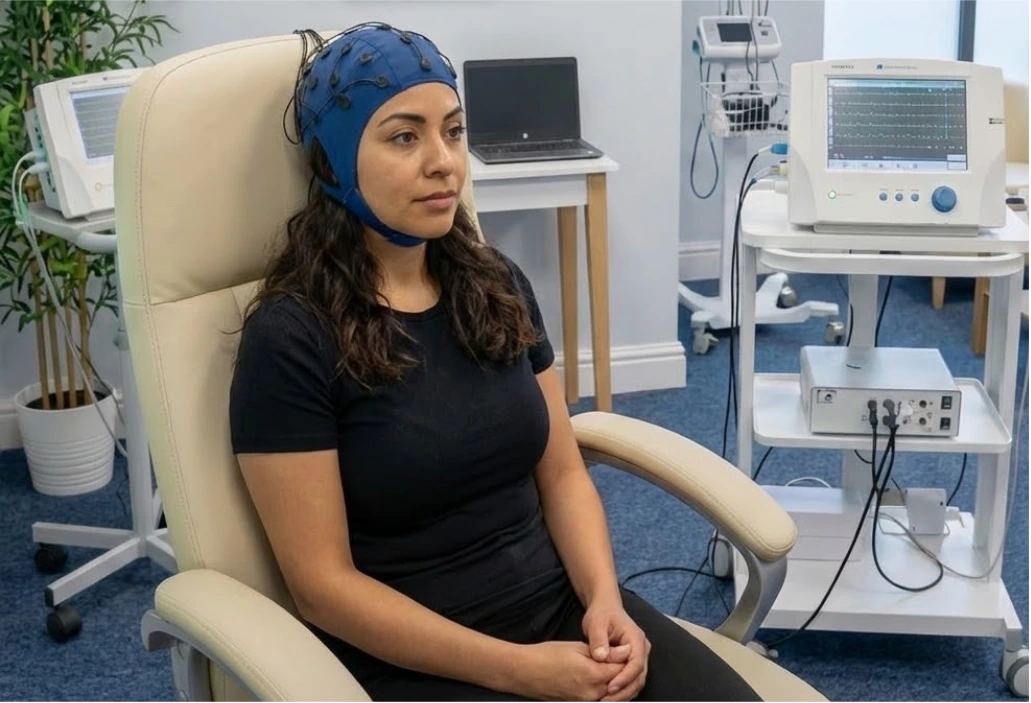
Step 4. Your Neurofeedback Sessions Begins: During each session, small sensors are placed comfortably on your scalp. You relax and watch a screen or listen to audio. When your brain produces healthier activity patterns, it receives instant positive feedback through the sights or sounds on the screen.
Step 5. Long-Term Results: Unlike medication, which only works while you're taking it, neurofeedback trains your brain to regulate itself. The results are designed to last well beyond your final session.

Yes, We Offer Financing &
0% Interest Options
We don't accept insurance, but we do offer flexible financing options. We work hard to keep your out-of-pocket cost as low as possible, sometimes even zero.
Got Questions? Talk With Our Team
Call the free helpline to get answers and a plan for care that’s best for your specific situation.. Even if it’s not with us.
Our patients highly recommend us
…happy patients, great reviews
I’ve struggled with anxiety and depression for years, and from my very first visit here I felt truly heard and supported. The team worked closely with me to tailor a plan that fit my needs and goals. They took the time to explain treatment options and always answered my questions with patience and compassion. I genuinely feel like I’m finally making real progress and highly recommend Natural Brain Healing for anyone ready to take the next step in their healing journey.


My name is Maribel and my son is a TBI patient we started going to this place last year 3 days a week I have seen a huge improvement on my son overall he sleep better and his speech improved a lot, he is more relaxed and calm, the owner takes the time to talk to my son and he treats us as family I highly recommend to stroke or TBI patients. We definitely continue with treatments to continue the improvement on my son, God is good and real he send me this angel to help us.

I was having problems with my digestive system; I would eat and couldn't digest the food, and I was gaining weight. Now I'm not gaining weight anymore, and after eating, I go to the bathroom like I should. My stomach is less bloated, and I work a lot with my hands, and they were always swollen or hurting after work. Now I feel like I'm 25 again, it's incredible! And let me tell you, yesterday my daughter went to the gym by herself here where I live, which means her energy is also coming back. We're both so happy, and she thanks me every time we're together. She tells me I'm the best mom for finding help for her, and that makes me so happy.😊thanks a lot God Bless your life more .

Thank you for all your help. I highly recommend

As a parent, I don’t usually write reviews, but I felt like I had to share our experience with Natural Brain Healing in Carrollton. My son has been struggling with ADHD for a while—he had a hard time focusing, would get overwhelmed easily, and school was becoming stressful for him (and honestly for us too). We really didn’t want to jump straight into medication, so we started looking into natural options and found their neurofeedback program. I’ll be honest, I wasn’t sure what to expect at first. But the team made us feel comfortable right away. They explained everything in a way that actually made sense and didn’t rush us into anything. After going through the sessions, we started noticing small changes… and then bigger ones. He's much calmer now, can focus better, and isn’t as easily frustrated. The biggest thing for me was hearing from his teacher that he’s doing better in class and staying on task. That meant everything. It’s not like everything changed overnight, but the progress has been real and consistent. He’s more confident, and school is no longer a daily struggle. If you’re a parent looking for help with ADHD, focus issues, or just want a non-medication approach like neurofeedback therapy, I would definitely recommend giving Natural brain Healing Carrollton a try. Really grateful we found this place.

I’ve been struggling with severe depression for a long time, and nothing seemed to help. It helped calm my mind, lift the heaviness,focus and slowly bring me back to myself Neurofeedback at Natural Brain Healing has made a real difference for me. Highly recommended !!!!!

Have Questions about Neurofeedback for Anxiety in Carrollton? Let’s Talk!
Call the free helpline to get answers and a plan for care that’s best for your specific situation.. Even if it’s not with us.
Online Support
Need someone to talk to? We’re always here.
No Commitment
Ask questions, get guidance. No obligation.
100% Private
Your story stays with us. Confidential support, always.
Fill out the form below to contact our team.
You'll talk with a specialist from your local community.

We help people in Carrollton and the surrounding Dallas area find relief from depression, anxiety, ADHD, brain fog, insomnia, and post-concussion symptoms, without relying on medication alone. Using proven, drug-free care methods like Neurofeedback, and TMS, we build a personalized plan around your brain, your symptoms, and your life.

This page is not affiliated with or endorsed by Google, Facebook, or any other platform used to promote these offers.
Disclaimer: This content is provided for educational and informational purposes only and is intended to support general understanding of neurofeedback concepts, nervous system functioning, self-regulation, and personal development. It is not medical advice, psychotherapy, or a substitute for professional medical, psychological, or mental health care, diagnosis, or treatment. It does not diagnose, treat, cure, or prevent any medical or psychological condition. This material does not constitute clinical neurofeedback therapy, psychiatric services, or crisis intervention. Engagement with this content should not replace care from licensed healthcare or mental health professionals. If you are experiencing severe psychological distress, suicidal thoughts, unmanaged trauma, or have a diagnosed mental health condition that requires clinical care or supervised neurofeedback, you are strongly encouraged to seek support from a qualified healthcare provider before engaging. The information, tools, and perspectives shared are intended to promote self-awareness, nervous system education, and skill development, and outcomes may vary between individuals. By engaging with this content, you acknowledge responsibility for your own physical, mental, and emotional well-being and choose to participate voluntarily and at your own discretion.